Skyscraper Sudoku: prove the move with two possible cases
Four cells, with one end lined up
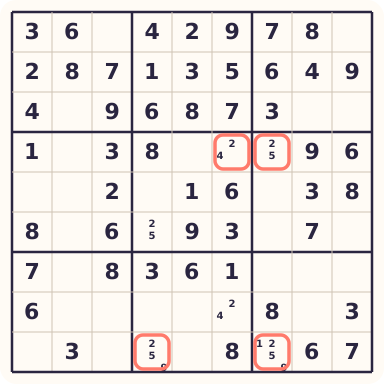
On the example board, row 4 has only two places for 2: r4c6 and r4c7. Row 9 also has only two: r9c4 and r9c7. Here r4c6 means row 4, column 6; count from the top and left.
The two cells in column 7 are the bases. The other two cells, r4c6 and r9c4, are the roofs. Focus on the candidate 2. Each cell can still contain other digits.
This position comes from the Morningwit raw generator, seed 3, requested with 24 givens. It actually produced 26 givens because the generator keeps a unique solution. The diagram shows the later position where the logic solver finds a Skyscraper, after earlier moves. These raw boards are outside the set served by the game.
Case A: put 2 in the upper base
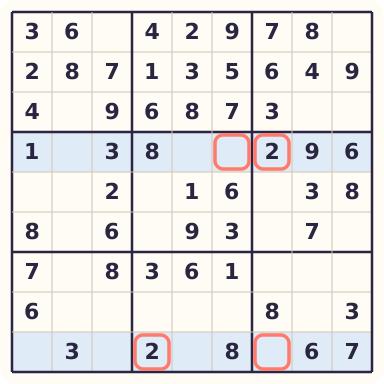
Suppose r4c7 is 2. Column 7 cannot contain another 2, so r9c7 cannot be 2. Row 9 has only one place left for it: r9c4, the lower roof.
The filled 2s in this diagram are conditional placements for the proof. They are not instructions to fill those cells on your board.
Case B leaves the upper roof
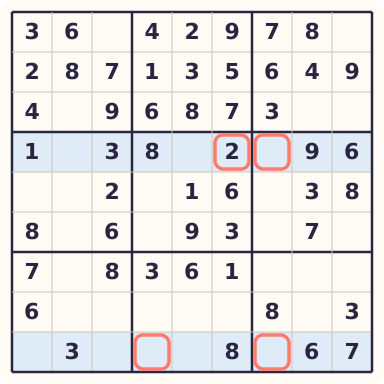
Now suppose r4c7 is not 2. Since row 4 has exactly two places for that digit, r4c6 must be 2. That is the upper roof. The lower row is still undecided.
These cases cover both possibilities for r4c7. Case A forces the lower roof; case B forces the upper roof. Therefore at least one roof holds 2. The argument does not say which one, or that exactly one roof is true.
The two pencil marks you can cross out
A cell sees another cell when they share a row, column or 3 by 3 box. Any outside cell seeing both roofs would clash with a 2 whichever roof is true.
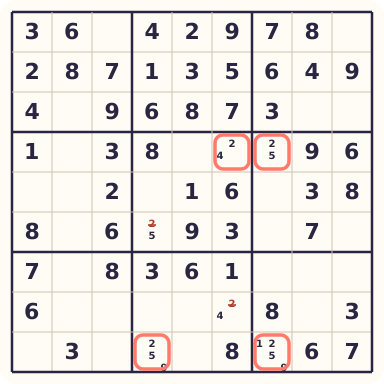
On this board, r6c4 sees the upper roof r4c6 through the center box and the lower roof r9c4 through column 4. Remove its candidate 2.
The other removal is r8c6: it sees r4c6 through column 6 and r9c4 through the bottom-middle box. Remove its 2 as well. Both removals were checked against the generated unique solution: neither cell contains 2 in that solution.
After removing the two candidates, look again for singles. The Skyscraper itself does not choose a roof or place a digit.
Where this proof breaks
If either starting row has a third candidate for 2, the forced move in the proof can fail. Recount the whole row, including candidates outside the highlighted boxes.
A target must see both roofs. Sharing a unit with just one roof is insufficient. Leave the four pattern cells alone when applying the elimination.
The pattern also works after swapping rows and columns. Unlike the X-Wing rectangle, these two roofs are in different crossing lines. This is a different scan from checking both ends of a rectangle.
How often the solver found it
A run of sudoku-example.ts on 300 raw boards, seeds 1000 through 1299, requested 24 givens per board. The solver used a Skyscraper in 33 of those solving paths. Its ordering tries simpler techniques first and includes Y-Wing at grade 5, so the count covers solving paths that used the technique. It does not count every pattern present on the boards.
Of those 300 boards, 190 finished within grade 4. Allowing both Skyscraper and Y-Wing finished another 34; 76 still remained unsolved by that set of techniques. The extra 34 cannot be attributed to Skyscraper alone. These figures do not describe the difficulty mix in the Morningwit Sudoku game, whose generator filters for completion within grade 4.
Questions
Do the four cells need only two pencil marks each?
No. Count the places where your chosen digit fits along each whole starting line: there must be two in one line and two in the other. Other digits in those cells do not affect that count.
Can both roofs contain the digit?
The basic proof guarantees at least one roof. It does not guarantee exactly one. Apply the common-peer elimination without choosing a roof.
Is trying both cases the same as guessing?
The cases prove one elimination that holds regardless of the upper base. You do not commit to either branch or enter its hypothetical digits on the puzzle.