W-Wing in Sudoku: two bivalue cells and a strong link
The pieces of a W-Wing
SudokuWiki describes a W-Wing as two bivalue cells with the same pair of digits, joined by a strong link on one of those digits. HoDoKu groups it with the other wing patterns that chain bivalue cells. You do not need to know ALS graphs to use the short form below.
Call the two bivalue cells A and B. Both contain only {X, Y}. A and B must not see each other; if they shared a row, column or box the pattern would collapse into something else.
Next find a strong link on X. In one unit, X appears as a candidate in exactly two squares, P and Q. One of those squares sees A (or is A). The other sees B (or is B). That strong link is the bridge.
The payoff is on Y. Any empty square that sees both A and B cannot be Y. If it were Y, then A and B would both be forced to X, but the strong link on X already says those two ends cannot both be X in a consistent way once the chain is read. The practical rule is simpler: once the W-Wing is on the board, cross Y out of the common peers of A and B.
A worked example on seed 1059
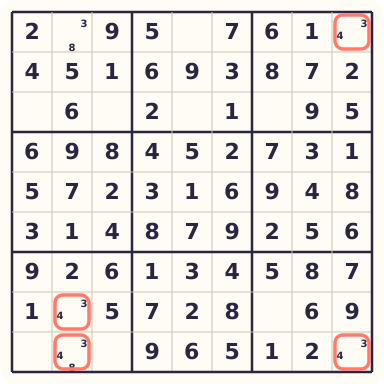
This board is a random one-solution puzzle with 24 givens, seed 1059. We ran every move the site's solver knows up to X-Wing: singles, pointing and claiming, naked pairs and triples, hidden pairs, and X-Wing. After 42 moves the board had 68 digits filled and was stuck. That is the position in the diagrams.
At that stall, row 1 column 9 is a bivalue cell on {3, 4}. Row 8 column 2 is the other bivalue cell on {3, 4}. They do not share a unit.
The strong link sits in row 9 on digit 4. The only two squares in row 9 that still allow 4 are row 9 column 2 and row 9 column 9. Row 9 column 9 sees the first bivalue cell (same column). Row 9 column 2 sees the second bivalue cell (same column). That is the bridge on 4.
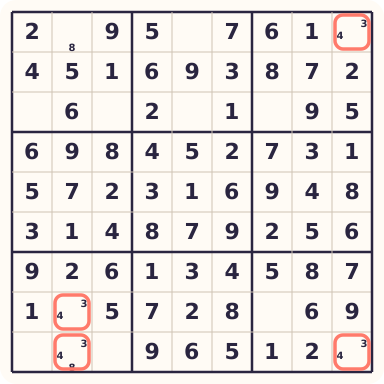
The other digit of the pair is 3. The common peer that still holds a 3 is row 1 column 2. After the W-Wing that 3 is gone. The square's remaining candidate is 8, which matches the board's only solution.
After the cut
Removing 3 from row 1 column 2 leaves 8 as a naked single. From there the solver needed only singles to finish. On a sample of 3,000 raw boards with about 24 givens, the same stall-and-check method found a solution-verified W-Wing on a large share of the boards that were stuck after X-Wing-level moves, and on many of those boards the cut let the ordinary solver finish. The exact counts belong in the notes for this page's review pack; the practical point is that W-Wing is common enough on hard random boards to be worth a dedicated scan when you are stuck.
Why the strong link matters
Without the strong link, two matching bivalue cells do not prove anything about their common peers. The strong link on X is what ties their fates together.
Read it as a short chain. Suppose a common peer is Y. Then A cannot be Y, so A is X. B cannot be Y, so B is X. But P and Q are the only two places for X in their unit, and they already see A and B on the X-bridge. Having both A and B forced to X overloads that strong link. The contradiction means the common peer was never Y.
You can reverse the labels. Bridge on Y, cut X from the common peers. On seed 1059 the bridge that fired was on 4, so the cut was on 3. The other orientation did not remove anything useful on that board.
Strong links also appear inside boxes. If digit X has only two candidates in a box, and those two squares see your bivalue cells the right way, the W-Wing is as valid as a row or column bridge. Box bridges are easy to miss because pencil marks in a box are denser.
How to scan
List every bivalue cell and group them by their digit pair. Pairs that appear only once cannot form a W-Wing.
For each pair of cells that share a pair {X, Y} and do not see each other, look for a strong link on X and for a strong link on Y. A strong link is any unit where that digit has exactly two candidate squares.
When a strong link on X ties a peer of A to a peer of B, mark every common peer of A and B and remove Y there. Then swap the roles of X and Y and check again.
Do this after Y-Wing and X-Wing if you already know those. W-Wing is a sibling of Y-Wing: both chain bivalue cells, but W-Wing uses a strong link on one digit instead of a third pivot cell.
Mistakes to avoid
Using two bivalue cells that already share a unit. That is not a W-Wing.
Claiming a strong link when the digit still has three or more candidates in the unit. Strong means exactly two.
Removing X instead of Y. The digit that rides the strong link stays; the other digit is the one you cut from the common peers.
Forgetting to check both orientations. A bridge on X removes Y; a bridge on Y removes X.
Where it sits among other strategies
If you already use Y-Wing, you have the right habits for W-Wing: find bivalue cells, then look for a connector. The connector here is a strong link instead of a third bivalue pivot.
If you already use X-Wing or Swordfish, you already scan for digits that live in only two or three lines. That same scan finds the strong links W-Wing needs.
When you are stuck, keep the usual order from the unstuck guide: singles and locked candidates first, then pairs, then fish and wings. W-Wing belongs with the wings, not before basic pairs.
Questions
Is a W-Wing the same as a Y-Wing?
No. Y-Wing needs three paired cells. W-Wing needs two paired cells plus one conjugate bridge.
Does the strong link have to be in a row?
Any house works. Columns and boxes count when they hold a two-square conjugate for the bridged digit.
Why was seed 1059 solved with only singles after the W-Wing?
After the cut, one square dropped to a single candidate (digit 8). On this seed that placement was enough to finish with ordinary singles.
Does the site's playable Sudoku need W-Wing?
No. Playable hard boards stop at Skyscraper and Y-Wing. W-Wing matters on tougher random grids and in advanced writeups.