XYZ-Wing in Sudoku: a three-digit pivot and two pincers
What the pattern looks like
Think of XYZ-Wing as a Y-Wing with one extra digit on the pivot. SudokuWiki presents it that way: the pivot carries three candidates, each pincer shares two of them, and the digit common to both pincers is the one you eliminate from the common seen cells.
Label the pivot's digits X, Y and Z. One pincer is a bivalue cell on {X, Z}. The other is a bivalue cell on {Y, Z}. Both pincers must see the pivot. They do not need to see each other.
Z is the hinge. Whatever digit the pivot finally takes, at least one of the pincers will be forced toward Z, and any cell that sees the whole triple cannot safely hold Z. The short rule: remove Z from every empty square that sees the pivot and both pincers.
Worked example, seed 1016
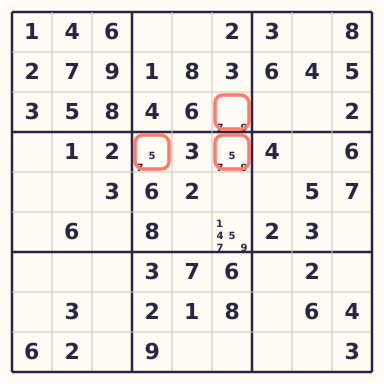
Board seed 1016 is another random one-solution puzzle with 24 givens. After singles, pointing pairs and the other grade-4 moves, 49 squares were filled and the solver stalled. That stalled grid is what the diagrams show.
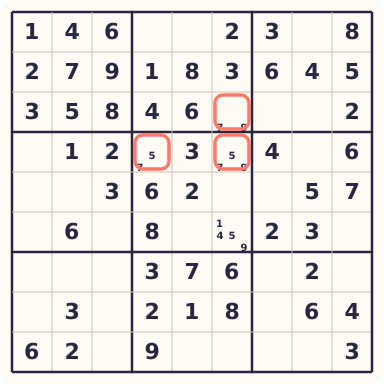
The pivot is row 4 column 6 with candidates {5, 7, 9}. One pincer is row 4 column 4 with {5, 7}. The other is row 3 column 6 with {7, 9}. Both pincers see the pivot: the first shares the row, the second shares the column.
The shared pincer digit is 7. The cell that sees all three and still holds a 7 is row 6 column 6. Crossing out that 7 is the XYZ-Wing. The square's remaining candidates are 1, 4, 5 and 9; the finished solution places 9 there, so the removed 7 was never needed.
Reading the logic without chains
Case on the pivot. If the pivot is 5, then the {5, 7} pincer becomes 7. If the pivot is 9, then the {7, 9} pincer becomes 7. If the pivot is already 7, then 7 sits in the pivot. In every case a 7 appears among the three cells. A fourth cell that sees all three cannot also be 7.
That case split is the whole proof. You never need to know which of the three digits the pivot will take. You only need the three cells and the common peer list.
On seed 1016 the cut alone did not finish the board; further moves were still required. That is normal. XYZ-Wing is a pruning move. Count it as progress when it removes a candidate that singles and pairs could not touch.
Pivot first, pincers second
A practical scan starts with trivalue cells because there are fewer of them than bivalue cells on a hard board. Each trivalue cell is a possible pivot.
From a pivot with {X, Y, Z}, you need one peer on {X, Z} and one peer on {Y, Z}. If you only find {X, Y} peers, you are looking at a different pattern (often a naked pair or a short chain), not an XYZ-Wing.
Write the three cells down before you eliminate anything. Name the hinge digit Z out loud. Then list every square that sees all three. Only those squares lose Z. Squares that see only two of the three keep their Z candidate.
On seed 1016 the common seen square that mattered was row 6 column 6. Other peers of the pivot did not see both pincers, so they were not part of the cut.
How to scan for one
Collect every cell with exactly three candidates. Those are pivot candidates.
For each pivot, look at its peers for bivalue cells whose two digits are a subset of the pivot's three. You need two such pincers that cover different pairs and share exactly one digit Z.
List squares that see the pivot and both pincers. Remove Z from those squares when it is present.
Run this scan after ordinary pairs and after Y-Wing. XYZ-Wing is rarer than Y-Wing on hard random boards, and the playable game never requires it, but it shows up on harder random grids once X-Wing-level moves are exhausted.
Related patterns and mistakes
Y-Wing is the two-digit cousin: the pivot is bivalue, not trivalue. See Y-Wing in Sudoku for the full pattern. W-Wing uses two matching bivalue cells and a strong link instead of a third pivot cell. X-Wing is a fish, not a wing.
Do not accept two pincers that hold the same pair. You need complementary pairs that together recreate the pivot's three digits.
Do not eliminate a digit other than Z. X and Y stay put unless a different pattern removes them.
Confirm that both pincers see the pivot. A bivalue cell that only sees one pincer is not part of this XYZ-Wing.
Practice tips
Mark bivalue and trivalue cells with a light highlight if you use a computer helper, or pencil a small ring if you solve on paper. Wings are hard to see in a sea of full pencil marks.
After any wing cut, immediately re-check singles in the affected row, column and box. Seed 1059's W-Wing became a naked single; seed 1016's XYZ-Wing did not, but the next pointing pair might.
Keep Unique Rectangle separate in your mind. UR needs a uniqueness assumption. XYZ-Wing does not. You can use XYZ-Wing even on puzzles where uniqueness is not advertised, though most published puzzles are unique anyway.
If two patterns seem to apply to the same square, apply the one you can prove in fewer sentences. A short naked pair beats a long wing when both remove the same candidate.
Questions
Why is it called XYZ-Wing?
Older guides labelled the pivot's three candidates X, Y and Z. The letters are teaching shorthand; any three digits work.
Must the two pincers see each other?
Each pincer only has to see the pivot. Mutual visibility between the pincers is optional and often absent.
What was removed on seed 1016?
The digit 7 left row 6 column 6. The unique completion puts 9 in that square, so dropping 7 was safe.
Is XYZ-Wing required on Morningwit play boards?
No. Play grading stops at Skyscraper and Y-Wing. Treat XYZ-Wing as an advanced add-on for harder published puzzles.