Unique Rectangle in Sudoku: deadly pattern and Type 1
The deadly pattern
Sudoku puzzles on this site, and in most published books, are built to have exactly one solution. A Unique Rectangle move is an appeal to that promise. You look for a shape that would force two solutions if it were left alone, then remove candidates so that shape cannot appear.
The shape is simple. Pick two rows and two columns. Their four crossings are the corners of a rectangle. Those four squares must also fall in exactly two of the 3x3 boxes, not four. Now suppose the only candidates left in all four corners are the same two digits, call them A and B. You could fill the rectangle as A-B on the first row and B-A on the second, or as B-A then A-B. Both fillings obey every Sudoku rule that touches those four squares. That is the deadly pattern.
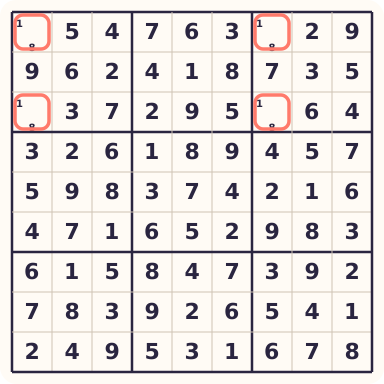
We made that pattern on purpose from a finished board. Starting from a random one-solution grid (raw seed 1 with 30 givens kept from its solution), we cleared only four corners: row 1 column 1, row 1 column 7, row 3 column 1 and row 3 column 7. The solver's solution counter then reports exactly two completions. They differ only by swapping 1 and 8 in those four squares. The diagram below shows the board at that point with both digits marked in each corner.
The two completions are not a quirk of one seed. Any time four corners in two boxes are left with only a shared pair, and the rest of the grid is otherwise fixed, a solution counter that allows multiple completions will report the swap. That is why published puzzles that promise a unique solution are designed to avoid leaving that pattern alive.
Why two boxes matter
If the four corners sat in four different boxes, the swap would usually break a box rule somewhere else, so the pattern would not be deadly. The two-box condition keeps both swap fillings legal inside every box as well as every row and column.
HoDoKu's Unique Rectangles page states the same floor: a potential unique rectangle needs two rows, two columns and two blocks. SudokuWiki opens with the same geometry and then lists numbered types for the useful cases. Type 1 is the one beginners meet first.
Type 1: three bi-value corners
Type 1 starts from the deadly pattern and adds one twist. Three of the four corners have been reduced to exactly {A, B}. The fourth corner, often called the roof, still contains A and B plus one or more extra digits.
If the roof were ever filled with an extra digit, the other three corners would still hold only A and B in a two-box rectangle. Completing the puzzle from there would recreate the deadly swap for those three corners plus a fourth cell that no longer blocks it. Under the uniqueness assumption that cannot happen. So the roof must be A or B, and every extra candidate in the roof can be crossed out.
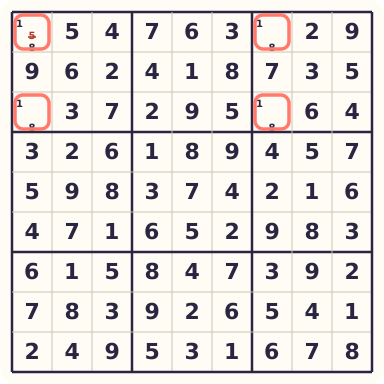
The second diagram takes the same seed-1 deadly board and shows what Type 1 looks like as a pencil-mark move. Three corners stay on {1, 8}. The roof at row 1 column 1 is drawn with an extra 5, and that 5 is struck through. On the real deadly board all four corners are already {1, 8} only, so Type 1 has nothing left to remove; the struck 5 is a teaching mark for the shape you will see on harder boards.
How to scan for Type 1
Work one digit pair at a time only when you are stuck after singles, locked candidates and naked or hidden pairs. Unique Rectangle is a uniqueness move; it is not the first tool to reach for on an easy board.
Scan for bi-value cells. When you see three bi-value cells that already form three corners of a two-box rectangle on the same pair {A, B}, look at the missing corner. If that roof still holds A and B plus extras, Type 1 applies: remove the extras.
Check the boxes. The four corners must occupy exactly two boxes. A rectangle that cuts four boxes is not a Unique Rectangle floor, even if the digits match.
After the cut, look for a naked single or a hidden single that the extras were blocking. On many boards Type 1 does not place a digit by itself; it only clears the way for ordinary moves.
On the seed-1 teaching board the deadly pattern is already fully formed, so Type 1 has no extra digit to remove. On a solving path you usually meet Type 1 first: three corners locked, one roof still dirty. Clear the roof, then look again for singles.
How this relates to other wings
Unique Rectangle is about uniqueness. Y-Wing and X-Wing are about forced candidates without that assumption. You can use all of them on the same board, but Unique Rectangle only makes sense when the puzzle is known to have one solution.
Morningwit play boards are graded up to Skyscraper and Y-Wing. Those boards never need Unique Rectangle. The pattern is still worth learning for harder books and for contest puzzles that advertise a unique solution.
If you are stuck before you start hunting rectangles, walk through the unstuck checklist first: singles, pointing pairs, naked pairs, then fish and wings.
Common mistakes
Treating any four cells with two digits as a Unique Rectangle. Without the two-box geometry, the swap is not deadly.
Removing A or B from the roof. Type 1 removes only the extras. The roof must keep both rectangle digits.
Using Unique Rectangle on a puzzle that might have more than one solution. The move assumes uniqueness. If a generator did not promise one solution, skip the move.
Calling Type 1 when only two corners are bi-value. You need three bi-value corners on the pair; fewer corners is a different UR type, or not a UR at all.
Questions
Does Unique Rectangle work without assuming a unique solution?
No. Without a uniqueness promise, finding that rectangle does not force any candidate out.
What is the difference between Type 1 and Type 2 Unique Rectangle?
Type 1 clears extras from a single dirty corner after three corners are locked on the pair. Type 2 instead finds the same extra digit in two corners and clears that digit from squares those corners both see. Later numbered types cover other floors.
Why did the worked example start from a finished grid?
We cleared four corners of a finished grid and asked the solution counter how many completions remained. It reported a pair that swaps two digits and nothing else, which is the clearest deadly-pattern demo.
Is Unique Rectangle the same as a naked quad?
No. A naked quad lives inside one unit and uses four digits without any uniqueness claim. The rectangle pattern uses two digits across two boxes and relies on uniqueness.