How to solve Sudoku when stuck: a pass/fail checklist
What stuck usually means
Stuck almost never means the puzzle needs a random guess on these graded easy, medium, and hard boards. It usually means a single or a locked-candidate clear is still sitting on the grid, or the pencil marks drifted after an earlier placement.
The checklist below is ordered by how often each move appears on this site's hard sample. Pointing showed up on 171 of 200 hard boards; hidden pairs on 9; X-Wing on 7. Climb the ladder in that order.
A useful split is true stuck versus fake stuck. True stuck means steps 1 to 4 all pass on clean marks and you still cannot place or eliminate. Fake stuck means you stopped scanning too early, trusted stale marks, or jumped to a rare pattern while a single or pointing clear was still open. Most boards that feel dead are fake stuck.
Keep a short log while you climb: which step failed, which unit you checked, and whether marks were rebuilt. The log stops you from looping the same empty stare. It also shows whether you ever ran step 3 at all. In the hard sample, skipping intersection clears is the usual reason a board feels frozen after singles.
Worked unlock: hard seed 40 (stuck after singles to pointing)
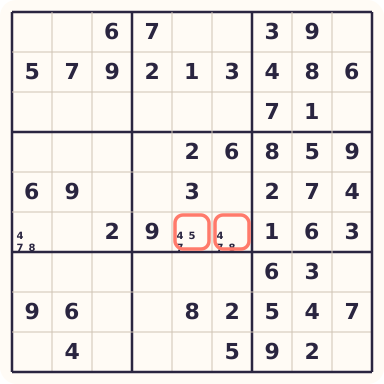
This site's generator and logic solver produced the hard board with seed 40. After placements and singles run as far as they can, the next productive move is a pointing pair in box 5: digit 7 remains only in r6c5 and r6c6, so box 5 locks 7 onto row 6.
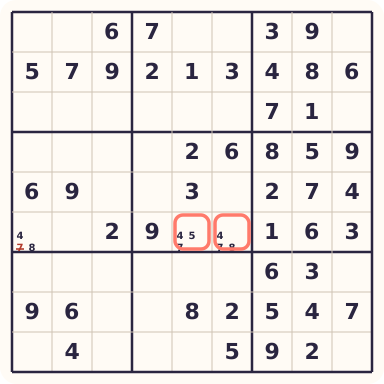
Before that clear, r6c1 still carries a 7 candidate even though box 5 has already forced 7 onto row 6 inside the box. That leftover mark is the failure signal for step 3 of the ladder. After the pointing step, r6c1 loses 7. No digit is placed yet; the unlock is an elimination that re-opens singles and further scans on row 6.
Level: hard. Seed: 40. Source: this site's game board generator, verified with the same solver used for the 200-board sample. The diagrams show the before and after pencil marks for the cells involved.
Read the before diagram as a stuck snapshot: singles have already been applied as far as the solver can go at that moment, yet r6c1 still shows a 7 that cannot survive the box-5 lock. That leftover candidate is exactly what step 3 is designed to catch. If your own pencil marks still show that 7 after you think you finished singles, you are not truly out of easy moves.
After the pointing unlock on seed 40
Same board after the pointing step. Row 6 no longer shows 7 outside box 5. Return to step 2 and place any new single, then continue the ladder. This is the pattern most "stuck" hard boards follow in the sample: an early intersection clear, not a guess.
Step 1: rewrite the marks
Pass: every empty cell lists only the digits that are still legal in its row, column, and box. Fail: any leftover digit that already appears as a given or a solved cell in the same unit.
Erase and rebuild marks when you have been stuck for more than a minute. Stale marks hide singles and create fake pairs. A fast failure signal is finding two identical "pairs" that share a digit already placed in the unit; that almost always means the pencil list was not rebuilt after the last placement.
Step 2: naked and hidden singles
Pass: no empty cell has only one candidate left (naked single), and no digit in any unit has only one remaining cell (hidden single). Fail: you can still place a digit without looking at pairs.
Hidden singles are easy to miss when marks are crowded. Scan by digit across a unit, not square by square. See the site guide on hidden singles. If you place even one new single, restart step 1 lightly: refresh marks in the three units that digit touched, then re-check singles before you climb further.
A practical pass order inside step 2 is rows, then columns, then boxes, always by digit. Stopping after a single row scan is a common way to declare stuck while a hidden single still sits in a box. Spend one full unit cycle before you decide singles are gone.
Step 3: pointing and claiming
Pass: for every box, each unsolved digit either spreads across more than one line or has already cleared the rest of its locked line. Fail: a digit is locked to one line inside a box, yet the same digit still sits on that line outside the box.
Pointing is the box-to-line clear. Claiming is the line-to-box clear. The seed 40 example above is pointing. Details and another worked board (hard seed 23) are in pointing pairs.
Failure signal: you keep staring at empty cells with two or three candidates and never inspect boxes digit-by-digit. That habit skips the move that unlocked 171 of 200 hard boards in the sample.
Claiming failure signal is the mirror image: along one row or column, a digit's remaining marks sit inside a single box, yet other empty cells in that box still show the digit off the line. Clear those box cells before you hunt pairs. Mixing up the arrow (pointing versus claiming) wastes a pass and can erase the wrong marks.
Step 4: pairs before rare wings
Pass: you have checked naked pairs/triples and hidden pairs in every unit that still has several empty cells. Fail: two cells in a unit list only the same two digits, or two digits share only the same two cells, and you have not cleaned them yet.
Use hidden pairs when the pair is buried under extra marks. Save X-Wing and skyscraper for boards that survive this step. On the 200-board hard sample those patterns were rare compared with pointing.
Step 5: when to stop, restart, or refuse a guess
If steps 1 to 4 all pass and you still cannot place or eliminate, rebuild marks once more and repeat from step 2. Do not branch into trial digits on these graded boards until the ladder has failed twice with clean marks.
Guessing versus the ladder: a trial digit can finish a board by luck, but it also hides the missed single or pointing clear and poisons later checks when the trial was wrong. On easy, medium, and hard boards from this generator, the logic path exists; treat guessing as a last resort after two clean ladder passes, not as a shortcut past step 3.
Another fake-stuck pattern is chasing X-Wing or Y-Wing because those names feel advanced, while a naked pair or pointing clear is still open. Frequency on the 200-board hard sample argues the opposite order: pointing on 171 boards, hidden pairs on 9, X-Wing on 7. Climb by frequency, not by prestige.
If the ladder fails twice with rebuilt marks on a graded board from this site, save the seed, reopen the same board in the playable Sudoku, and watch which technique the helper exposes next. Use that as a teaching check, then redo the ladder by hand on a fresh seed so the skill sticks.
For speed habits after you are unstuck, the companion page how to solve Sudoku quickly covers Snyder marks and scan order. For a fresh board, open Sudoku play.
Questions
Why do I get stuck on Sudoku even on medium boards?
Usually a placeable digit, a box-to-line wipe, or stale pencil marks are still on the grid. Refresh candidates, finish every true single, then scan intersections before subset pairs.
Should I guess when I am stuck?
Not while the five-step ladder still has unchecked boxes. Complete two passes on freshly rebuilt candidates first. A trial digit hides the skipped move and corrupts later checks.
What technique should I try after singles?
Intersection removals next. Across the 200 hard boards behind this checklist they show up far more often than subset pairs or fish patterns, so climb there before rarer tools.
How many steps does a hard board usually take?
For the hard sample behind this checklist, the middle-of-pack solve sat near sixty logic moves, with only a handful of those moves being pure eliminations. Treat the numbers as scale, not a promise for one seed.