Sudoku patterns: which techniques to learn in order
What counts as a pattern
A useful pattern names both the shape and the deletion rule. Naked pair means two cells in one unit hold exactly the same two candidates, so those two digits leave every other cell in that unit. Hidden pair means two digits appear only inside the same two cells of a unit, so every other candidate leaves those two cells. Pointing pair means a digit's remaining candidates inside one box sit on a single line, so that digit leaves the rest of the line outside the box.
SudokuWiki's strategy families page is the map: singles, naked sets, hidden sets, then intersection removal. Later families (chains, uniqueness, exotic patterns) build on those locks rather than replacing them. If a tip sheet jumps straight to X-Wing, it is skipping the moves that clear many hard boards after basic locks.
Pattern ladder (learn in this order)
<div style="overflow-x:auto;"><table style="width:100%;border-collapse:collapse;font-size:0.9rem;min-width:520px;"><thead><tr><th style="text-align:left;padding:8px 10px;border-bottom:2px solid var(--ink);">Pattern family</th><th style="text-align:left;padding:8px 10px;border-bottom:2px solid var(--ink);">What you look for</th><th style="text-align:left;padding:8px 10px;border-bottom:2px solid var(--ink);">What you delete or place</th></tr></thead><tbody><tr><td style="padding:8px 10px;border-bottom:1px solid var(--rule);">Naked / hidden singles</td><td style="padding:8px 10px;border-bottom:1px solid var(--rule);">One candidate left in a cell, or one place left for a digit in a unit</td><td style="padding:8px 10px;border-bottom:1px solid var(--rule);">Place the digit</td></tr><tr><td style="padding:8px 10px;border-bottom:1px solid var(--rule);">Naked pairs / triples</td><td style="padding:8px 10px;border-bottom:1px solid var(--rule);">Two or three cells whose candidates stay inside a set of that size</td><td style="padding:8px 10px;border-bottom:1px solid var(--rule);">Strip those digits from the rest of the unit</td></tr><tr><td style="padding:8px 10px;border-bottom:1px solid var(--rule);">Hidden pairs / triples</td><td style="padding:8px 10px;border-bottom:1px solid var(--rule);">Two or three digits that appear only inside the same two or three cells of a unit</td><td style="padding:8px 10px;border-bottom:1px solid var(--rule);">Strip extra candidates from those cells</td></tr><tr><td style="padding:8px 10px;border-bottom:1px solid var(--rule);">Pointing pairs / box-line</td><td style="padding:8px 10px;border-bottom:1px solid var(--rule);">A digit locked to one line inside a box, or to one box along a line</td><td style="padding:8px 10px;border-bottom:1px solid var(--rule);">Clear the digit from the rest of that line or box</td></tr></tbody></table></div>
That order matches how SudokuWiki's solver enables basic tests before tougher strategies. Skipping singles to hunt an X-Wing wastes time on boards that still have easy placements. Claiming (the line-to-box twin of pointing) sits in the same intersection family; learn pointing first, then flip the scan.
Worked naked pair (hard seed 1)
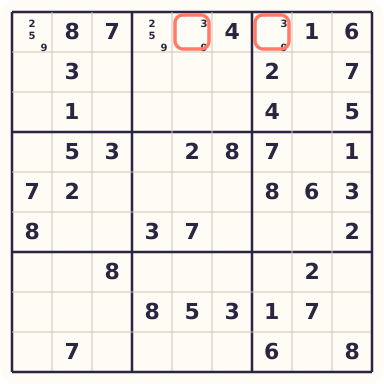
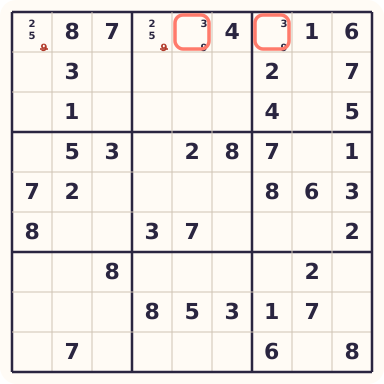
This site's hard board with seed 1 produces a naked pair early enough to show the deletion rule without fish. The solver finds that r1c5 and r1c7 can only hold 3 and 9 between them. Those two cells use up both digits in row 1.
Because the pair occupies 3 and 9, every other empty cell in row 1 loses those candidates. On this board the clear hits r1c1 and r1c4 (both lose 9). You have not placed a 3 or a 9 yet. You only removed illegal marks so later singles can appear.
Generate the same diagrams with `node tools/sudoku-example.ts --tech naked-subset --size 2 --level hard --start 1 --write`. The before board shows the pair cells and the struck candidates; the after board shows row 1 after the strip.
After the naked pair clear
Same board after the naked-subset step. Row 1 no longer shows 9 outside the pair cells. If your pencil marks still show a 9 in r1c1, either the pair was incomplete or you skipped updating marks after an earlier placement.
Worked pointing pair (hard seed 1)
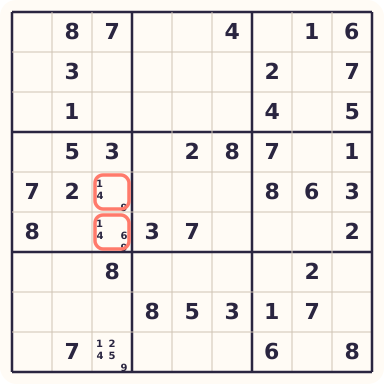
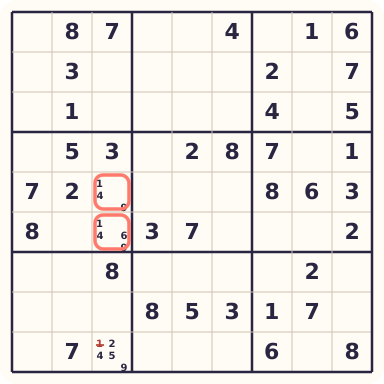
The same hard seed also shows intersection removal. In box 4, every square that can still take a 1 lies in column 3 (r5c3 and r6c3). The box needs its 1 on that column, so no other square in column 3 outside the box can be a 1.
On this board the elimination is r9c3 loses 1. Pointing is one digit locked to a line inside a box; it is not the same object as a naked pair of two digits. Confusing the two words is the most common beginner mix-up on pattern pages.
Command: `node tools/sudoku-example.ts --tech pointing --level hard --start 1 --write`. Diagrams: before and after for the pointing lock.
After the pointing clear
Column 3 no longer carries a 1 outside box 4. Again, nothing was placed; only a candidate left. Follow any new single that the clear creates before hunting another fancy shape.
Failure signals that fake a pattern
Incomplete pencil marks: if a third cell still holds a digit you forgot to write, your naked pair is fictional and the deletion is wrong. Always refresh candidates after every placement.
Near-miss pairs: two cells that almost share {3,9} but one still holds a 5 are not a naked pair. Deleting 3 and 9 from the unit will break a live candidate.
Pointing without a true lock: if the digit still has a candidate in another line of the same box, the box has not locked onto one line. Clearing the line outside the box would be illegal.
Jumping to claiming or X-Wing while singles remain: claiming is the line-to-box twin of pointing and belongs in the same family, but it still assumes clean marks. X-Wing is a fish pattern; SudokuWiki places it after basic intersection work. On this site's hard boards, X-Wing is rare compared with pointing.
How patterns connect to pages on this site
Hidden singles are covered in the hidden single guide. Pointing locks are covered in pointing pairs. Hidden pairs have their own walkthrough in hidden pairs. Naked triples sit in the same naked-candidate family as pairs on SudokuWiki's Naked Candidates page.
When you are stuck after this ladder, use the ordered scan in how to solve Sudoku when stuck before guessing. Chains and uniqueness still depend on clean candidates produced by these early patterns.
Common mix-ups
A naked pair is about shared candidates in two cells. A pointing pair is about one digit's positions inside a box. Using the same word "pair" for both is why written guides keep the family name attached.
Patterns also fail when you treat a visual rectangle as an X-Wing without checking that the digit has exactly two candidates in each of two rows (or columns). Shape without the candidate count is decoration, not a pattern.
Guessing is not a pattern. If you place a digit to see what happens and backtrack, you left the classical ladder. Finish singles, pairs, and pointing first; many "I had to guess" hard boards still had a pointing or pair left after a careful scan.
Questions
What are the most important Sudoku patterns for beginners?
Build the early ladder in order: forced placements first, then two-cell locks, then box-line clears. Leave chain work until those stop yielding moves.
Is an X-Wing a beginner pattern?
No. Finish the basic ladder first. Fish patterns such as X-Wing belong after candidates are already clean from pairs and pointing.
Do Sudoku patterns require guessing?
Classical patterns are elimination rules, not trial and error. Needing a trial digit and undo means you stepped outside that set.
Where should I read the formal definitions?
Use Andrew Stuart's public technique pages for pairs, triples, and pointing locks; they are the usual shared reference set. This site's worked boards use the same names with seeds you can regenerate.