Pointing pairs in Sudoku: when a box locks a whole line
The lock in one sentence
Scan one box for a digit that still has candidates, but those candidates all sit in a single row or a single column of that box. Two cells make a pointing pair; three make a pointing triple. Either way the box has forced that digit onto that line, so the rest of the line outside the box cannot keep it.
SudokuWiki groups this under Intersection Removal and also calls it pointing. HoDoKu labels the same move Locked Candidates Type 1. The reverse direction (a digit locked to one box along a line, then cleared from the rest of that box) is claiming, or Locked Candidates Type 2, which is a separate page of work.
Worked board (hard seed 23)
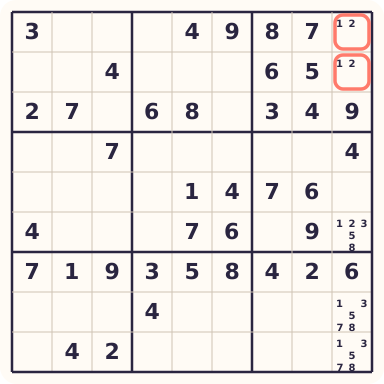
On this site's hard board with seed 23, the first pointing step the solver finds is in box 3 (top-right). Digit 1 still appears only in r1c9 and r2c9. Both cells sit in column 9, so box 3 has locked its 1 onto column 9.
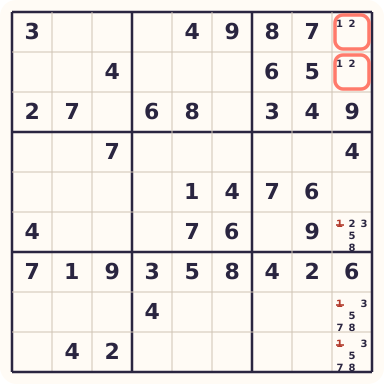
That lock clears 1 from every other empty cell in column 9 outside box 3. On this board the removals are r6c9, r8c9, and r9c9. Three candidates leave in one move, and none of those three cells was part of the pointing pair itself.
The diagrams below show the before and after pencil marks for the cells involved. The pair cells keep their 1 candidates; the struck marks are the ones column 9 loses outside the box.
After the clear
Same board after the pointing step. Column 9 no longer shows 1 outside box 3. You have not placed a 1 yet. You only removed illegal marks. Follow any new single or pair that appears next.
How to scan without guessing
Finish naked and hidden singles first, then write full pencil marks. Pointing is a box-first scan: for each of the nine boxes, and for each digit 1 through 9 that is still missing from that box, list every empty cell in the box that still shows the digit. If that list has length 2 or 3 and those cells share one row or one column, you have a pointing pair or triple.
Work one box completely before you jump to another. A common loop is boxes 1 to 9 in reading order, then a second pass because an earlier clear can create a new lock elsewhere. Inside each box, scan digits in order rather than chasing the first pair you notice; that keeps you from skipping a digit that already has a clean lock.
Pass/fail check before you erase anything: (1) the digit really has no other candidate cell inside that box, (2) the shared line is the only alignment of those marks, and (3) at least one cell on that line outside the box still shows the digit. If check 3 fails, the pattern is real but there is nothing to remove yet. Leave the marks alone and move on.
When check 3 passes, erase the digit only from the line cells that sit outside the locking box. Then re-check naked and hidden singles in the affected row or column and in the two neighboring boxes on that line. Many pointing clears open a single on the next look.
False positives and near misses
The most common false positive is a digit that looks lined up in two cells of a box while a third candidate for the same digit still sits elsewhere in that box, off the shared line. That is not a pointing pair. All remaining marks for the digit inside the box must sit on the shared line. If the third cell is still live, clear singles or other eliminations first until the digit collapses onto one line, or accept that this box has no pointing move for that digit yet.
A second near miss is counting cells that already hold a different placed digit, or counting a cell whose pencil mark for that digit was already removed. Rebuild marks for the box before you claim a lock. Stale marks invent pairs that the live grid does not support.
A third near miss is clearing the digit from the pointing cells themselves. Those cells are where the digit still belongs. Only the rest of the line outside the box loses the mark.
Pointing versus claiming
Pointing and claiming use the same intersection of a box and a line, but the arrow points opposite ways. Pointing starts inside the box: the digit is locked to one line inside that box, so the rest of that line outside the box must drop the digit. Claiming starts on the line: the digit is locked to one box along that line, so the rest of that box off the line must drop the digit.
HoDoKu calls pointing Locked Candidates Type 1 and claiming Type 2. SudokuWiki puts both under Intersection Removal. If you catch yourself starting on a row and then wiping marks inside a box, you are doing claiming, not pointing. Both are legal; keep the names straight so you erase the right cells.
A quick self-check: write down which unit you inspected first. If the first unit was a box, expect a line clear (pointing). If the first unit was a row or column, expect a box clear (claiming).
Second board: row lock on hard seed 40
Column locks are not the only shape. Hard seed 40 from the same generator shows the solver's first pointing step in box 5 (center). Digit 7 remains only in r6c5 and r6c6. Both cells sit in row 6, so box 5 has locked its 7 onto row 6.
That clear removes 7 from r6c1 outside the box. Same rule as seed 23, different orientation: the shared line is a row instead of a column, and only one outside cell still carried the digit. After the erase, re-scan row 6 and box 4 for new singles.
You will also meet pointing triples, where three candidate cells for a digit fill one full line inside a box. The cleanup outside the box is identical. Multi-box boards often chain: one pointing clear creates a single, that single creates a second pointing lock in a neighboring box. Follow the chain instead of hunting rare wings too early.
Common mistakes
Do not erase the digit from the pointing cells themselves. Those cells are where the digit still belongs.
Do not treat a digit that still has a third cell elsewhere in the box as a pointing pair. All of its remaining marks in the box must sit on the shared line.
Do not confuse pointing with box/line reduction (claiming). Pointing starts in the box and clears the line. Claiming starts on the line and clears the rest of the box.
How often it shows up here
On 200 hard boards from this site's generator (seeds 1000 to 1199), every board solved with logic, and 171 of them used at least one pointing step. That is far more often than a hidden pair on the same set (9 boards) or an X-Wing (7 boards). If singles have stalled, pointing is usually the next place to look before you reach for rarer patterns.
You can try the same family of moves in the playable Sudoku on this site, then come back to hidden pairs or X-Wing when the board needs a harder clear.
Questions
What is a pointing pair in Sudoku?
A box has forced one digit onto a single row or column because that is where all of its leftover marks sit. Clean that digit off the same row or column in the neighboring boxes.
Is a pointing triple different?
No new rule. Two or three aligned leftover marks for one digit still force the same cleanup on the shared line outside that box.
Pointing pair vs box/line reduction?
One move exports a digit restriction from a box onto a row or column. The other imports a digit restriction from a row or column into a box. Same intersection, flipped arrow.
When should I look for pointing pairs?
Once singles stop placing digits and every empty cell has fresh pencil marks. In the hard-board sample for this guide, pointing showed up on most boards, so treat it as an early intermediate scan rather than a last resort.
What basics come before pointing pairs?
Sweep hidden singles and naked singles first. Pointing is a box scan that assumes your pencil marks are current.