Naked pair in Sudoku: two squares, two digits, a cleared line
What you are looking for
Fill in candidates first, then look for squares with exactly two. A naked pair is two of those squares, in the same row, column or box, that list the very same two digits. Not one digit in common, not three digits between them: the same two, and only those two.
"Naked" is the opposite of the hidden pair. In a hidden pair the two squares are cluttered with other candidates and the pattern is about where two digits can go. In a naked pair the squares themselves are bare, so you can spot it by looking at the squares rather than tracing digits.
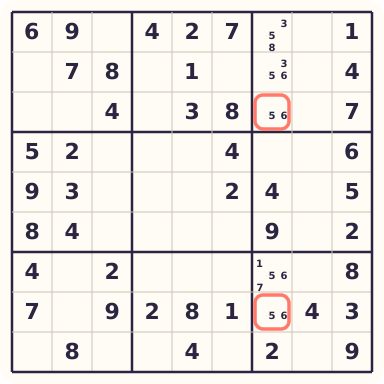
On the board below, column 7 has two squares that can only hold a 5 or a 6: row 3 and row 8. They are far apart and in different boxes, which is fine. All that matters is that they sit in the same column.
Why it works
Column 7 needs one 5 and one 6. Row 3, column 7 has to be one of them, because it has no other candidate. Row 8, column 7 is the same. Say row 3 takes the 5. Then row 8 cannot also be a 5 in the same column, so it takes the 6. If row 3 takes the 6, row 8 takes the 5.
Either way, those two squares use up the column's 5 and its 6. No other square in column 7 can hold either digit, because that would put a second 5 or a second 6 in the column. You do not need to know which order is right to make the cut.
The same logic works in a row or a box. What the two squares share decides where the digits come out: the row, the column, or the box that both squares sit in.
What it clears on this board
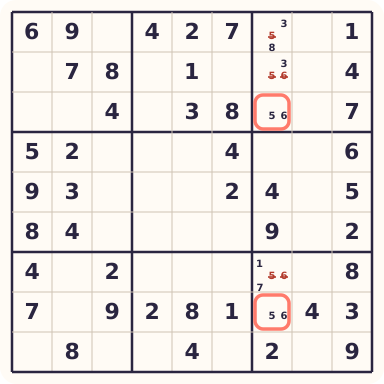
This board is seed 2 of the hard boards the game generates, at step 22 of the solver's run. Here is column 7 at that moment, and what is left after the pair does its work.
<div style="overflow-x:auto;"><table style="width:100%;border-collapse:collapse;font-size:0.9rem;min-width:480px;"><thead><tr><th style="text-align:left;padding:8px 10px;border-bottom:2px solid var(--ink);">Square in column 7</th><th style="text-align:left;padding:8px 10px;border-bottom:2px solid var(--ink);">Candidates before</th><th style="text-align:left;padding:8px 10px;border-bottom:2px solid var(--ink);">After the pair</th></tr></thead><tbody><tr><td style="padding:8px 10px;border-bottom:1px solid var(--rule, #ddd);vertical-align:top;">Row 1</td><td style="padding:8px 10px;border-bottom:1px solid var(--rule, #ddd);vertical-align:top;">3, 5, 8</td><td style="padding:8px 10px;border-bottom:1px solid var(--rule, #ddd);vertical-align:top;">3, 8</td></tr><tr><td style="padding:8px 10px;border-bottom:1px solid var(--rule, #ddd);vertical-align:top;">Row 2</td><td style="padding:8px 10px;border-bottom:1px solid var(--rule, #ddd);vertical-align:top;">3, 5, 6</td><td style="padding:8px 10px;border-bottom:1px solid var(--rule, #ddd);vertical-align:top;">3 (now a single)</td></tr><tr><td style="padding:8px 10px;border-bottom:1px solid var(--rule, #ddd);vertical-align:top;">Row 3</td><td style="padding:8px 10px;border-bottom:1px solid var(--rule, #ddd);vertical-align:top;">5, 6</td><td style="padding:8px 10px;border-bottom:1px solid var(--rule, #ddd);vertical-align:top;">5, 6 (pair)</td></tr><tr><td style="padding:8px 10px;border-bottom:1px solid var(--rule, #ddd);vertical-align:top;">Row 4</td><td style="padding:8px 10px;border-bottom:1px solid var(--rule, #ddd);vertical-align:top;">1, 3, 7, 8</td><td style="padding:8px 10px;border-bottom:1px solid var(--rule, #ddd);vertical-align:top;">unchanged</td></tr><tr><td style="padding:8px 10px;border-bottom:1px solid var(--rule, #ddd);vertical-align:top;">Row 5</td><td style="padding:8px 10px;border-bottom:1px solid var(--rule, #ddd);vertical-align:top;">4 (solved)</td><td style="padding:8px 10px;border-bottom:1px solid var(--rule, #ddd);vertical-align:top;">4</td></tr><tr><td style="padding:8px 10px;border-bottom:1px solid var(--rule, #ddd);vertical-align:top;">Row 6</td><td style="padding:8px 10px;border-bottom:1px solid var(--rule, #ddd);vertical-align:top;">9 (solved)</td><td style="padding:8px 10px;border-bottom:1px solid var(--rule, #ddd);vertical-align:top;">9</td></tr><tr><td style="padding:8px 10px;border-bottom:1px solid var(--rule, #ddd);vertical-align:top;">Row 7</td><td style="padding:8px 10px;border-bottom:1px solid var(--rule, #ddd);vertical-align:top;">1, 5, 6, 7</td><td style="padding:8px 10px;border-bottom:1px solid var(--rule, #ddd);vertical-align:top;">1, 7</td></tr><tr><td style="padding:8px 10px;border-bottom:1px solid var(--rule, #ddd);vertical-align:top;">Row 8</td><td style="padding:8px 10px;border-bottom:1px solid var(--rule, #ddd);vertical-align:top;">5, 6</td><td style="padding:8px 10px;border-bottom:1px solid var(--rule, #ddd);vertical-align:top;">5, 6 (pair)</td></tr><tr><td style="padding:8px 10px;border-bottom:1px solid var(--rule, #ddd);vertical-align:top;">Row 9</td><td style="padding:8px 10px;border-bottom:1px solid var(--rule, #ddd);vertical-align:top;">2 (solved)</td><td style="padding:8px 10px;border-bottom:1px solid var(--rule, #ddd);vertical-align:top;">2</td></tr></tbody></table></div>
Five candidates go: the 5 from row 1, the 5 and 6 from row 2, and the 5 and 6 from row 7. Row 4 lists neither digit, so it is untouched. The three solved squares are not affected either.
That is enough to restart the board. Row 2, column 7 is left with only a 3, so the 3 goes in as a naked single. Then row 1, column 7, which had been down to 3 and 8, loses the 3 and becomes an 8. The solver's next six moves were all naked singles.
When the pair shares a box too
Sometimes the two squares sit in the same box and the same row, or the same box and the same column. Then the pair counts twice. The HoDoKu solving guide calls this a locked pair and notes that candidates can be eliminated from both houses, meaning the line and the box.
The pair on this board is not locked: rows 3 and 8 are in different boxes. But it is worth checking every time, because it is easy to clear the line and forget the box. In the 400 boards counted below, 76 of the 280 naked pair moves the solver made, a little over a quarter, used two squares that shared a box as well as a line. The solver logs one move per row, column or box it clears, so a locked pair can appear as two moves: one for the line and one for the box.
How often you will need it
We ran the game's own solver on 200 medium and 200 hard boards, seeds 1000 to 1199, and counted naked pair moves. The solver always tries simpler moves first, so a naked pair is only counted when singles, pointing and claiming had run out.
<div style="overflow-x:auto;"><table style="width:100%;border-collapse:collapse;font-size:0.9rem;min-width:480px;"><thead><tr><th style="text-align:left;padding:8px 10px;border-bottom:2px solid var(--ink);">Measure (200 boards each, seeds 1000 to 1199)</th><th style="text-align:left;padding:8px 10px;border-bottom:2px solid var(--ink);">Medium</th><th style="text-align:left;padding:8px 10px;border-bottom:2px solid var(--ink);">Hard</th></tr></thead><tbody><tr><td style="padding:8px 10px;border-bottom:1px solid var(--rule, #ddd);vertical-align:top;">Boards that needed at least one naked pair</td><td style="padding:8px 10px;border-bottom:1px solid var(--rule, #ddd);vertical-align:top;">48 (24%)</td><td style="padding:8px 10px;border-bottom:1px solid var(--rule, #ddd);vertical-align:top;">166 (83%)</td></tr><tr><td style="padding:8px 10px;border-bottom:1px solid var(--rule, #ddd);vertical-align:top;">Naked pair moves in total</td><td style="padding:8px 10px;border-bottom:1px solid var(--rule, #ddd);vertical-align:top;">63</td><td style="padding:8px 10px;border-bottom:1px solid var(--rule, #ddd);vertical-align:top;">217</td></tr><tr><td style="padding:8px 10px;border-bottom:1px solid var(--rule, #ddd);vertical-align:top;">Average per board that used one</td><td style="padding:8px 10px;border-bottom:1px solid var(--rule, #ddd);vertical-align:top;">1.31</td><td style="padding:8px 10px;border-bottom:1px solid var(--rule, #ddd);vertical-align:top;">1.31</td></tr><tr><td style="padding:8px 10px;border-bottom:1px solid var(--rule, #ddd);vertical-align:top;">Most on a single board</td><td style="padding:8px 10px;border-bottom:1px solid var(--rule, #ddd);vertical-align:top;">3</td><td style="padding:8px 10px;border-bottom:1px solid var(--rule, #ddd);vertical-align:top;">4</td></tr><tr><td style="padding:8px 10px;border-bottom:1px solid var(--rule, #ddd);vertical-align:top;">Average candidates removed per move</td><td style="padding:8px 10px;border-bottom:1px solid var(--rule, #ddd);vertical-align:top;">2.79</td><td style="padding:8px 10px;border-bottom:1px solid var(--rule, #ddd);vertical-align:top;">3.29</td></tr><tr><td style="padding:8px 10px;border-bottom:1px solid var(--rule, #ddd);vertical-align:top;">Most removed by one move</td><td style="padding:8px 10px;border-bottom:1px solid var(--rule, #ddd);vertical-align:top;">7</td><td style="padding:8px 10px;border-bottom:1px solid var(--rule, #ddd);vertical-align:top;">10</td></tr><tr><td style="padding:8px 10px;border-bottom:1px solid var(--rule, #ddd);vertical-align:top;">Moves whose two squares also shared a box and a line</td><td style="padding:8px 10px;border-bottom:1px solid var(--rule, #ddd);vertical-align:top;">11 of 63</td><td style="padding:8px 10px;border-bottom:1px solid var(--rule, #ddd);vertical-align:top;">65 of 217</td></tr><tr><td style="padding:8px 10px;border-bottom:1px solid var(--rule, #ddd);vertical-align:top;">Boards that needed a naked triple</td><td style="padding:8px 10px;border-bottom:1px solid var(--rule, #ddd);vertical-align:top;">6</td><td style="padding:8px 10px;border-bottom:1px solid var(--rule, #ddd);vertical-align:top;">49</td></tr></tbody></table></div>
So on medium boards you may not need it at all; on hard boards you almost certainly will. When a board needs one, it usually needs one or two. That matches what we found on the sudoku patterns page: among the moves beyond singles, pointing and naked pairs come up the most.
One caution on reading the numbers. The solver scans rows first, then columns, then boxes, and reports the first place it finds a pair. On hard boards it filed 118 pairs under rows, 89 under columns and only 10 under boxes. That split says more about the scan order than about where pairs hide, so check boxes as carefully as lines.
Naked pair or naked triple?
A naked triple is the same idea with three squares and three digits, and it is easy to confuse the two. The difference is in what each square has to show. In a pair, both squares list exactly the same two digits. In a triple, the HoDoKu guide points out that not every square has to list all three digits; the rule is that the three squares together list no more than three. So squares showing 3 and 9, 3 and 6, and 6 and 9 form a triple, even though no square has all three.
That makes triples much harder to see. On our hard boards, naked triples were needed on 49 boards against 166 for pairs. Learn to spot pairs first: once you check squares with two candidates by habit, a triple is one more square to add to the comparison.
How to scan for one, and mistakes that break it
Work one row, column or box at a time. Note every square with exactly two candidates. If two of them list the same two digits, you have a pair; cross those digits out of the rest of that row, column or box, and then check whether the two squares also share a box or a line. The auto-notes button on the Sudoku page fills in candidates so you can practise this on hard boards.
Three slips cause most wrong eliminations. The first is two squares that share only one digit, such as 5 and 6 next to 5 and 8. That is not a pair. The second is a pair that is not in a common row, column or box; two squares listing 5 and 6 in different rows, columns and boxes tell you nothing about each other. The third is crossing out in the wrong place: digits come out only of houses both squares belong to.
It also pays to know when to stop looking. If a row, column or box has only two empty squares left, they will always list the same two digits, but there is nothing else in that house to cross out, so the pair gives you nothing there. The useful pairs are the ones in houses with at least three open squares, where the cut can reach a third square. On the example board, column 7 had six open squares, which is why one pair removed five candidates.
Stale pencil marks cause a quieter error. If a square still lists a digit that has already been placed elsewhere in its row, it can hide a pair that is really there, or suggest one that is not. Keep the notes current before you start looking.
Questions
Does a naked pair place a digit?
No. It only removes candidates. In our worked example the cut left one square with a single option, and that is when a digit went in. Source: this site's solver run on hard board seed 2.
Do the two squares have to be next to each other?
No. They just have to share a line or a box. In our example they are five rows apart in column 7. Source: SudokuWiki, Naked Candidates page.
What is a locked pair?
It is a naked pair whose squares sit in one box and also in one row or column, so its two digits can be removed from both. Source: HoDoKu, Naked Subsets guide.
What should I learn next after naked pairs?
On hard boards, hidden singles and pointing pairs usually appear earlier in the solve. Run those scans before you hunt wing patterns.